
Performance Louvres Guide Singapore: Rain Defence, Airflow & Acoustic Specs
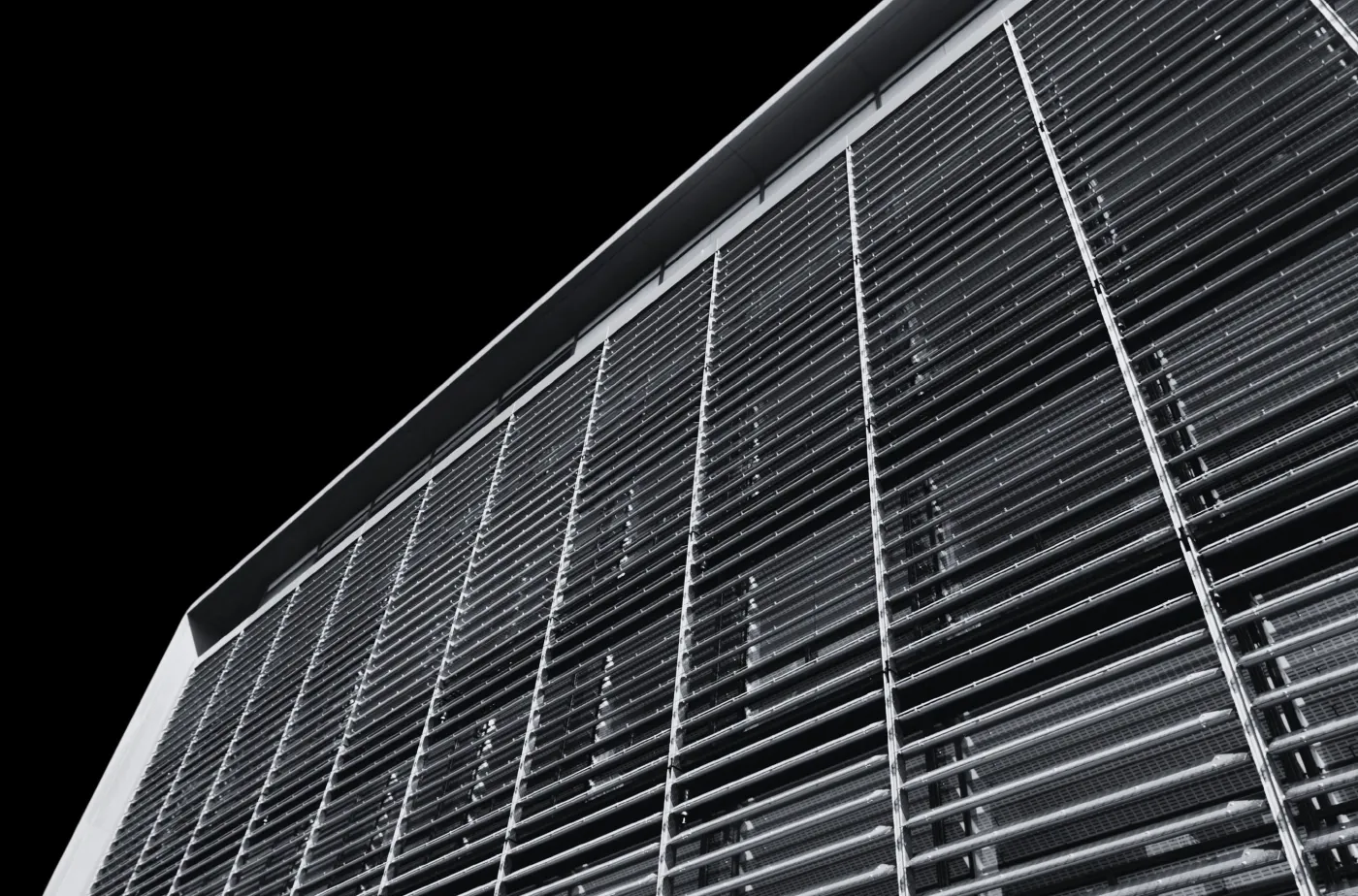
Quick Answer
Performance louvres are 3-in-1 engineered architectural systems that combine wind-driven rain defence (BS EN 13030 Class A), high aerodynamic airflow (Class 1 discharge coefficients), and acoustic sound attenuation (ASTM E90 up to 31 dB). They are designed exclusively for commercial and industrial facilities—such as data centres, SP Group substations, and central chiller plants—not residential homes.
Architectural performance louvres are not domestic home windows.
While residential louvre windows provide natural daylighting and casual ventilation for HDB bathrooms or service yards, performance louvres are heavy-duty, engineered building envelope assemblies. They are deployed across data centres, SP Group electrical substations, central chiller plants, and commercial high-rises—where mechanical equipment must exchange massive volumes of air without admitting driving rain or radiating noise into surrounding neighborhoods.
The 3-in-1 Engineering Balance
Every commercial plant room and substation faces three conflicting requirements:
- Weather Defence: Stop monsoonal driving rain from entering electrical and IT spaces.
- Aerodynamic Airflow: Deliver high airflow with minimal static pressure drop so fans run efficiently.
- Acoustic Attenuation: Muffle equipment drone (chillers, fans, generators) to meet municipal boundary noise laws.
Modern performance louvres integrate all three functions into a single certified architectural system.
1. Wind-Driven Rain Defence (BS EN 13030 Class A)
Singapore's intense tropical monsoon rains frequently combine with wind gusts over 10–15 m/s. Standard gravity-based water tests cannot simulate these conditions.
WSS performance louvres are tested to BS EN 13030:2001 by BSRIA (UK) under simulated storm conditions (75 mm/hr rainfall and 13 m/s wind):
| Rain Defence Class | Water Rejection | Max Penetration | Application |
|---|---|---|---|
| Class A (WSS Standard) | 99.0% – 100.0% | $\le 0.75\text{ }l/h/m^2$ | Data centres, electrical substations, switch rooms |
| Class B | 95.0% – 98.9% | $3.75\text{ }l/h/m^2$ | Sheltered mechanical rooms, carpark exhaust |
| Class C | 80.0% – 94.9% | $15.00\text{ }l/h/m^2$ | Architectural screening where minor water ingress is tolerable |
| Class D | Below 80.0% | $> 15.00\text{ }l/h/m^2$ | Visual screening only; no verified weather protection |
Key Takeaway: For mission-critical facilities, specify Class A across design face velocities (such as the MPL-250V, which maintains 100% Class A rain rejection up to 3.5 m/s).
2. Airflow Efficiency & BCA Green Mark
High airflow resistance forces HVAC designers to specify larger fan motors, increasing energy usage for the life of the building.
Under BS EN 13030, aerodynamic efficiency is measured by the Discharge Loss Coefficient ($C_d$):
- Class 1 (Highest Efficiency): $C_d \ge 0.400$ (e.g., WSS APL-175 at $C_d = 0.466$)
- Class 2: $0.300 \le C_d < 0.399$
- Class 3: $0.200 \le C_d < 0.299$
- Class 4: $C_d < 0.200$
BCA Green Mark Impact: Lower static pressure loss ($\Delta P$) across the louvre core reduces fan motor power consumption, directly supporting BCA Green Mark (GM:2021) and BCA-IMDA Green Mark for Data Centres (GM:DC) energy targets.
3. Acoustic Attenuation & Singapore NEA Noise Limits
Under Singapore's Environmental Protection and Management (Boundary Noise Limits for Factory Premises) Regulations, commercial equipment noise measured at site boundaries cannot exceed statutory limits:
| Boundary Receptor | Day (07:00–19:00) | Evening (19:00–23:00) | Night (23:00–07:00) |
|---|---|---|---|
| Noise-Sensitive (Hospitals, schools) | 60 dBA | 55 dBA | 50 dBA |
| Residential Premises | 65 dBA | 60 dBA | 55 dBA |
| Commercial Premises | 70 dBA | 65 dBA | 60 dBA |
Note: Equipment with dominant tonal or low-frequency rumble incurs an additional +5 dBA penalty during NEA inspections.
Acoustic Louvre Solution: WSS ACL Series louvres are tested to ASTM E90 by Riverbank Acoustical Laboratories (USA):
- ACL-300S (Double Blade): Up to 31 dB noise reduction (STC 15) for heavy chillers, cooling towers, and backup generators.
- ACL-150S (Single Blade): Up to 24 dB noise reduction (STC 11) for compact plant rooms and carparks.
- Tropicalized Media: Packed with non-hygroscopic, fire-retardant rockwool with micro-perforated facing to resist Singapore's 90%+ humidity without moisture absorption or mould.
System Comparison at a Glance
| System Family | Blade Configuration | Key Strengths | Best For |
|---|---|---|---|
Hidden Mullion (APL) |
Single/double/triple bank horizontal | Unbroken architectural lines, $C_d$ up to 0.466 | High-rise façades, commercial podiums |
Visible Mullion (MPL/VPL) |
Horizontal or vertical chevron blades | 100% Class A rain rejection, modular assembly | Data centres, SP Group substations |
Acoustic (ACL) |
Single or double acoustic blades | Up to 31 dB noise reduction, lab-certified | Chillers, generator compounds, cooling towers |
Key Commercial Applications
- Data Centres: High-volume CFM airflow for cooling halls with zero water ingress into UPS/switchgear rooms (MPL-250V + ACL-300S).
- SP Group Substations: 24/7 passive thermal chimney ventilation with insect/vermin screening and 100% monsoonal storm defence.
- Rooftop Chiller Enclosures: Acoustic attenuation perimeter barriers meeting nighttime NEA 55 dBA residential boundary limits.
- Commercial Façades: Continuous horizontal unbroken sightlines concealing mechanical plenums behind architectural cladding (APL Series).
5-Point Specification Checklist
When preparing drawings and schedules for tender, MEP consultants should specify:
- Design Airflow & Velocity: Required flow rate ($m^3/s$ or CFM) and face velocity across the net opening.
- Allowable Pressure Drop: Maximum static pressure loss in Pascals (Pa).
- Rain Defence Class: BS EN 13030 Class A (critical plant rooms) or Class B/C (sheltered service areas).
- Target Noise Reduction: Required sound attenuation (dB) or STC based on equipment Sound Power Levels ($L_w$) and distance to the boundary.
- Architectural Finish: AAMA 2605 PVDF fluorocarbon (20+ year UV retention) or Qualicoat architectural powder coating in standard RAL colours.
Singapore Factory-Direct Fabrication
WSS manufactures architectural performance louvres locally at our 22,000 sq ft facility at 11 Senoko Drive:
- Custom dimensions and mullion depths engineered to project drawings.
- Airflow and acoustic attenuation calculations for mechanical schedules.
- Full CAD (.dwg) and BIM details with certified BSRIA and Riverbank lab test reports.
- Fast local delivery without overseas shipping delays.
Enquiries & Tender Reviews: Contact our engineering team at info@wss.com.sg or explore our complete Performance Louvres Specifications. For residential domestic windows (HDB, condo, or landed), please visit Residential Louvre Windows.